

Equipo and the Big Stick Era: How ACOs Move from Insight to Control in Value-Based Care
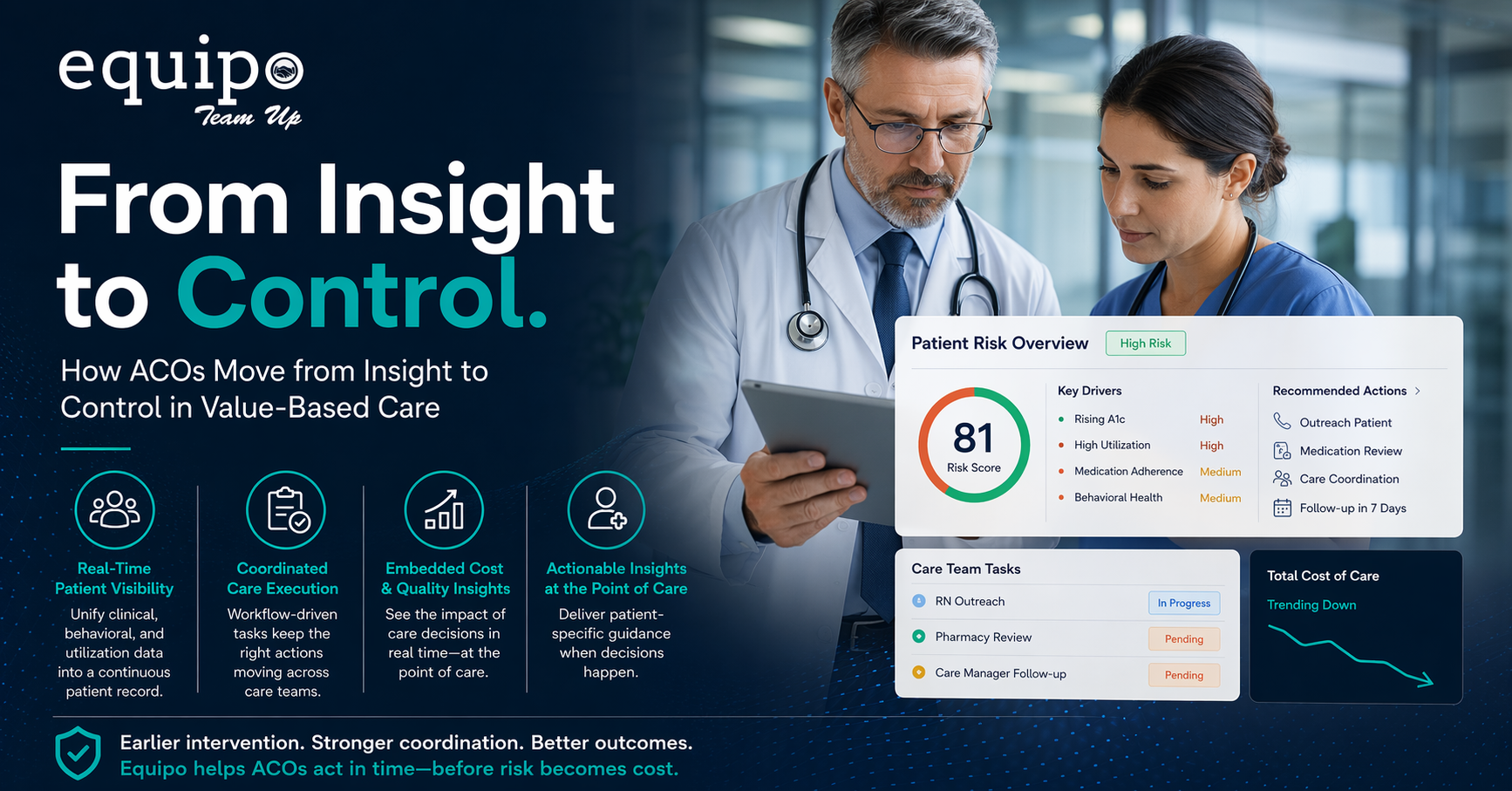
Equipo enables ACOs to move from delayed insights to real-time action with continuous patient visibility, coordinated workflows, and point-of-care decision support.

Turning patient insights into timely action is where ACO performance improves.
Equipo enables ACOs to act on patient risk earlier with real-time data, coordinated workflows, and point-of-care insights.
SOUTH PLAINFIELD, NJ, UNITED STATES, April 17, 2026 /EINPresswire.com/ -- Equipo is built for one clear purpose in value-based care: helping ACOs act on patient risk while it is still manageable. It unifies clinical, behavioral, and utilization data into a real-time longitudinal record, coordinates care across teams through workflow-driven execution, and delivers patient-specific insights during care interactions. This allows earlier intervention, consistent follow-through, and clearer alignment between clinical actions and financial outcomes.CMS has moved decisively. Value-based care is now tied to tighter timelines, stronger accountability, and more immediate financial impact. The shift is visible in how performance is measured and how quickly results translate into incentives or penalties.
For ACO leaders, this creates a very specific experience.
There is awareness of where the organization stands: quality scores, utilization trends, rising-risk cohorts. There is also a growing sense that these insights arrive a step too late. Care gaps are identified, but often after they have already influenced outcomes. High-risk patients are known, but engagement happens after escalation. Teams are active, yet coordination feels uneven.That gap between knowing and influencing is where most ACO performance is determined. It comes from how systems are structured.
Data lives across EHRs, claims, and care management tools. It is assembled periodically and reviewed in cycles. Care coordination relies on human follow-through across disconnected workflows. Performance metrics are tracked, but they are not always visible during the moment of care. Each of these introduces delay. Under fee-for-service, delay was tolerable. Under value-based care, delay converts directly into cost and quality variation.
CMS is defining a different operating expectation through its LEAD role, and this shows up in practical terms.
Longitudinal accountability means ACOs must continuously track patient status across time, not just during encounters. This requires a living patient record that reflects current risk, not historical summaries.
Embedded coordination means care transitions, follow-ups, and interventions must happen reliably across settings. This requires workflows that carry tasks forward without depending on manual tracking.
Aligned incentives in execution means clinicians need visibility into how their actions affect cost and quality while care is being delivered. This requires performance signals to be present inside workflows, not isolated in reports.
Distributed decision-making means insights must reach the point of care instantly. This requires systems that deliver patient-specific guidance during interactions, not after outcomes are finalized.
These expectations define how value-based care functions operationally. The challenge is that many ACOs are not yet structured this way.
An ACO may identify a diabetic population with rising A1c levels. The operational question is whether outreach, medication adjustment, and follow-up happen early enough to prevent complications.
An ACO may track readmission rates. The operational question is whether discharge planning, follow-up calls, and care transitions are consistently executed across every patient.
An ACO may monitor total cost of care. The operational question is whether care teams can influence utilization before it occurs.
Each of these scenarios points to the same requirement: the ability to act in time.This is where Equipo becomes relevant in a direct and measurable way. It creates a continuous patient view, allowing risk signals to surface early instead of during retrospective review. It operationalizes coordination by assigning and tracking tasks across care teams, ensuring that follow-ups, referrals, and transitions are completed without gaps. It embeds cost and quality signals into workflows, so clinicians understand the impact of their actions during care delivery. It delivers insights at the point of care, enabling immediate decisions rather than delayed adjustments.
The result is a shift in how performance is managed.Risk is identified earlier, which changes intervention timing. Coordination becomes consistent, which reduces variation in care delivery. Decisions happen with context, which improves both clinical and financial outcomes.
For ACO leaders, this changes the nature of control. Instead of managing performance through periodic reviews, organizations begin to influence outcomes continuously. Instead of reacting to utilization patterns, they shape them. Instead of measuring gaps after they occur, they close them while care is still in motion.
This is the difference between insight and execution.There is often a moment in value-based care where organizations recognize that strategy, contracts, and data are in place, yet results are not moving at the expected pace. That moment usually reflects a missing operational layer, where insight does not translate into timely action.
Addressing that layer requires systems that connect data, workflows, and decisions without delay. Understanding what Equipo does helps clarify this. It functions as execution infrastructure within value-based care, where patient visibility, care coordination, and decision-making are aligned in real time.
CMS has established the direction. The pressure on performance will continue to increase.The ACOs that respond by building real-time operational control where risk is visible early, coordination is reliable, and decisions happen in context will be able to manage cost and quality with greater precision. Others will continue to experience performance gaps that become visible only after outcomes are already determined.
Prince Mamman
Connect Care
+1 732-221-1050
email us here
Visit us on social media:
LinkedIn
Instagram
Care conversations podcast
Legal Disclaimer:
EIN Presswire provides this news content "as is" without warranty of any kind. We do not accept any responsibility or liability for the accuracy, content, images, videos, licenses, completeness, legality, or reliability of the information contained in this article. If you have any complaints or copyright issues related to this article, kindly contact the author above.
